
LaGrange County Court Record Requests
Start with MyCase. Jot down the case number, the court, the file date, the case type, and the exact document or event title. Go no further without those details. Then check Indiana's public-access table. It spells out whether a given document can be viewed from home, only at a court, or not by the public at all. A public case header alone never promises remote images of the filings.
If something is missing online, call or visit Kimberley Johnson, LaGrange County Clerk. Ask for the records counter. Mail, fax, and email submission rules, payment methods, pickup, and ID requirements can vary. So ask before you send money or personal data.
- Find the cause in MyCase and note the full case number.
- Name the court, filing date, and exact document or event.
- Choose inspection, plain copy, certified copy, or transcript.
- Call the Clerk to confirm access, cost, submission, and delivery.
- Use the reporter, not the Clerk, to order an original transcript.
LaGrange County Clerk Records Counter
LaGrange County runs on a unified clerk structure. One Clerk serves both LaGrange Circuit Court and LaGrange Superior Court. The office indexes every filing, preserves paper and electronic case files, keeps court-cost accounting, issues copies, coordinates the shared jury pool, and fields access questions. A prosecutor's ticket clerk can help with citation intake questions. Even so, that office never replaces the Clerk as keeper of the court file.
LaGrange County Clerk
Kimberley Johnson, Clerk
105 North Detroit Street
LaGrange, IN 46761
(260) 499-6371
Maintaining Courts
LaGrange Circuit Court: (260) 499-6358
LaGrange Superior Court: (260) 499-6363
Both courts use the same courthouse address.
The official LaGrange County court page tells visitors to contact the court for copies that are not online. When you do, give staff a narrow description of the document rather than asking for every record tied to a name.
Kinds of LaGrange Court Records
What you ask for matters. It changes the custodian, the fee, and the legal weight of the product. A docket, or Case Summary, is a dated index of public events. A filed document is the actual pleading, motion, order, judgment, or exhibit named in an event. A certified copy adds the Clerk's certification. A transcript is different. It is the court reporter's written record of what was said in the proceedings.
- Case Summary or docket printout for procedural history
- Public pleading, motion, order, judgment, or exhibit
- Certified judgment or order for an official-use need
- Current Clerk accounting or judgment balance
- Court reporter transcript of a hearing or trial
- Historical index, case book, or microfilm reference
A free MyCase row cannot substitute for certification. And a transcript is not the same thing as the filed order that followed a hearing.
When a LaGrange Document Is Offline
Indiana's access matrix shifts by case type. Some public cases show non-confidential orders but hold back other documents. Felony and misdemeanor matters often expose sentencing orders remotely. Other filed images take a different route. Juvenile, mental-health, sealed, and protection-order material may be excluded or limited. Indiana's official MyCase access table lays out each category.
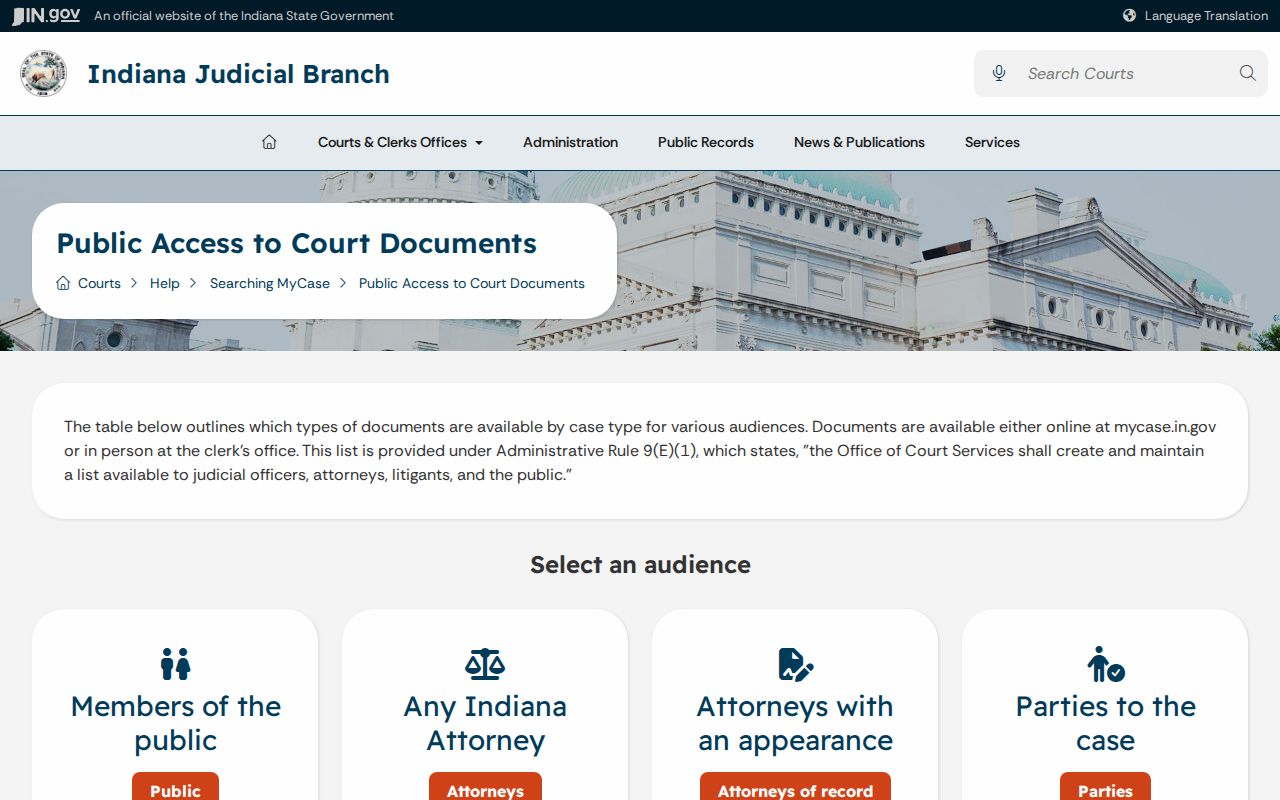
That matrix explains why a visible docket can lack a downloadable filing. Ask the maintaining court whether lawful in-person inspection or a copy is possible. Never assume the file is missing, and never try to work around a restriction.
Key point: A listed document that cannot be downloaded may still be open at the courthouse, but the court must decide the proper access route.
LaGrange Court Records: What They Contain
A LaGrange County court case record comes in layers. Header facts fix the cause and the court. Party and attorney blocks name the public roles. The event register lists filings, settings, orders, and dispositions, while filed images and financial data appear only when access and system rules permit.
| Case header | Case number, court, file date, type, style, and status. |
|---|---|
| Parties and counsel | Public names and roles, subject to masking or exclusion. |
| Case events | Dated filings, hearings, notices, orders, and outcomes. |
| Documents | Public images or titles allowed for that case type. |
| Settings | Hearing details that should be checked against the current notice. |
| Financial indicators | Potentially stale figures that require Clerk confirmation. |
A converted event can simply mark the move into Odyssey rather than a new act in the case. When a portal field and the Clerk's record disagree, the official file controls.
County Files Are Not Court Files
LaGrange County's Document Center holds administrative material: meeting minutes, public notices, contracts, and agency PDFs. It is not a backup copy of MyCase. Court pleadings and orders follow the Clerk and the Indiana Administrative Rules instead. An administrative county record may fall under the Indiana Public Records Act, though that statute cannot unlock a confidential court file.
The official County Document Center supplies the grouped interface view the county assigns to these records.

Its title, type, department, category, topic, and year controls help you find county business records. A court cause still lives in MyCase or at the Clerk's counter.
Copy Fees and Certification
Indiana's current trial-court fee manual sets the cost anchors. Copy or statutory transcript preparation runs no more than $1 per page. A certificate costs $1. A record transcript of judgment costs $3 under the cited IC 33-37-5 provisions. These are official ceilings, not a promise of your final charge. Confirm the product, page count, certification, delivery, and payment method with the Clerk.
| Record product | Official amount or rule |
|---|---|
| Copy or statutory transcript preparation | Not more than $1 per page |
| Certificate | $1 |
| Record transcript of judgment | $3 |
| Private reporter transcript | Maximum $4.50 per page |
| Expedited reporter transcript | No less than $7 per page within five working days |
LaGrange County's local rules set the reporter rate, which applies to spoken proceedings in court. Want an existing transcript copied? That charge follows the Clerk copy rate instead. Filing fees to open a case are separate entirely, so don't confuse them with what it costs to copy a court record.
IEFS Is Not a Record Search
The Indiana E-Filing System moves documents into trial courts through certified service providers. Attorneys work under mandatory e-filing rules. Self-represented filers sit on a different track under the schedule. Remember what IEFS is: a filing channel, nothing more. It will not surface a LaGrange County court docket. Picking an e-filing provider never opens a public case file for you.
For provider lists, instructions, and filing schedules, the state's e-filing page is the official resource.
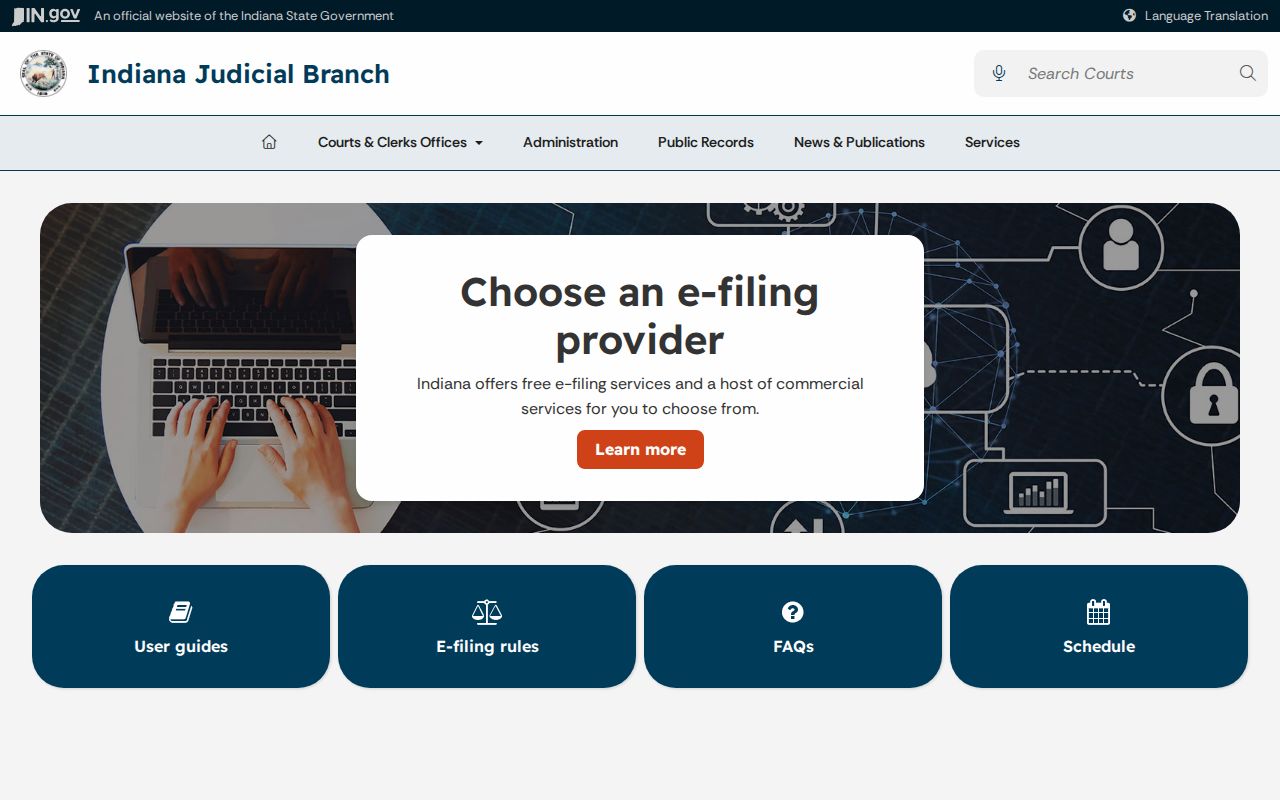
That statewide page covers providers, instructions, and schedules, not case lookup. To pull an actual filed document from a LaGrange County case, go through MyCase or the Clerk.
Older LaGrange County Court Records
LaGrange County dates to 1832. Its oldest court books and indexes were kept on paper, long before electronic case management existed. MyCase and Odyssey cover current cases well. But a historical entry that never made it online may sit in the Clerk's paper index, a transferred archive, or on microfilm, which is where the State Library LaGrange research guide and its microfilm inventory come in. The guide points to who holds original records. The inventory lists court, circuit, common-pleas, index, and civil-cause coverage for stated periods.
Ask the Clerk first. Staff can tell you whether a book is still local or has moved to a historical repository. When you request an older index search, bring names, date ranges, court type, and any book or cause reference you know.
Access Rules for LaGrange Court Records
Indiana keeps its access rules in one place. Indiana Administrative Rule 1 opens the courthouse doors. Then it balances that openness against privacy, safety, and the need for courts to run well. Rules 2 and 4 spell out what public access means. They also define what counts as a court record. Rule 5 sets aside confidential categories. It also requires masking of Social Security numbers, account numbers, PINs, passwords, and similar identifiers. Rule 9 controls remote, courthouse, and compiled access.
Sealed files, mental-health matters, protected juvenile material, confidential identifiers, and records excluded by law or order do not become public through a general records request.
One ordinary public file follows a simple chain. Use MyCase, call the court, or go to the Clerk's counter. Then file a narrow copy request. A bulk dataset is different. Indiana handles large compiled data through a separate Administrative Rule 9(F) process. That is not the route for a single LaGrange County case. Nor does the Rule 9 procedure for extraordinary relief offer a way around a sealed case.