
LaGrange County Criminal Docket Searches
Start free and anonymous at MyCase, Indiana Courts Public Case Search. Pick Case or Name mode. Choose LaGrange County, and set the category to Criminal & Citation. A full case number works best. Without one, search a last name and add only the filters that help. Expect a CAPTCHA after repeated queries; the public interface is not built for data mining.
- Open MyCase and choose Case Search.
- Enter the full case number, or use a last name in Name mode.
- Select LaGrange County, Criminal & Citation, and the needed status.
- Open the match and verify court, case type, style, file date, and status.
- Read the newest events, then confirm an urgent date or official copy with the court.
Phone the clerk when a docket search online comes up empty. Clerk Kimberley Johnson’s office is (260) 499-6371. Circuit Court is (260) 499-6358. Superior Court is (260) 499-6363. The counter sits at 105 North Detroit Street, LaGrange, Indiana 46761. Ask about public inspection, plain or certified copies, or an older court record. Before mailing or faxing anything, confirm what request, payment, and delivery method the clerk accepts.
LaGrange Criminal Docket Court Codes
The two trial courts carry distinct identifiers under Indiana Rule 8. Circuit is 44C01; Superior is 44D01. A modern case number adds year and month, a case type, and a six-digit sequence. So 44C01-2501-CM-000123 displays each part without pointing to a real case. Keep the hyphens and leading zeroes. Otherwise a false result becomes likely.
A transfer can swap the prefix. Recusal, a judge change, or reassignment may move the file. A dismissed case that is refiled usually lands back in the same court. When a number seems incomplete, run both codes and check cross references. The official Indiana case-number rule spells out the structure.
Criminal Dockets: What They Show
MyCase labels its public register a Case Summary. Case type and access rules decide how much appears. An event row may name a filing without showing its image. Calendar-linked criminal records add schedule fields too, which helps separate a future hearing date from the full case history.
| Case identity | Number, county and court code, court, style, file date, type, and public or active indicators. |
|---|---|
| People and counsel | Public party roles and attorney blocks, subject to access limits. |
| Charges | Charge or citation fields when public; the summary is not the charging instrument. |
| Events | Filings, motions, hearings, orders, pleas, resets, judgments, sentencing, and appeals when available. |
| Setting | Description, date, time, location, judge, court contact, time zone, and refresh time. |
| Documents | Permitted public links; an online image is not a certified copy. |
Read rows by date, event label, court, and document link. Then weigh the newest order or notice against the next setting. “Closed” is a status, not a ruling on the merits; the disposition entry or signed order carries that meaning.
LaGrange Criminal Docket Type Codes
Type codes narrow a LaGrange County criminal docket search and mark the filing class. They never prove the final charge or the result. Because older court records were converted into Odyssey, current and legacy labels can both show up.
- CM
- Criminal misdemeanor.
- F1 through F6
- Felony types grouped by level.
- CF
- Legacy criminal felony code.
- MC
- Miscellaneous criminal.
- MR
- Murder case type.
- CR
- Criminal key used in calendar data.
Keep classification and outcome separate. A later docket event can amend a count, dismiss part of the case, or record a different result.
Criminal Case Stages on the Docket
The register tracks procedure, not a story of proof. A typical LaGrange County criminal docket opens with filing, then shows an initial hearing, pretrial conference, status hearing, motion, plea, trial event, order, disposition, and sentencing. Summons or warrant events and appeal entries may appear as well. Labels vary, and converted events may carry older terms.
Docket flow: Filing › Initial Hearing › Pretrial › Plea or Trial › Disposition › Sentencing
Local rules set disclosure duties between the state and defense. They do not promise public access to discovery. Discovery, sealed exhibits, and other protected material may never appear as downloads, so a docket may show only that an event occurred.
LaGrange Criminal Hearing Calendar
The Indiana Court Calendar is a separate tool from MyCase. LaGrange County currently lists Circuit and Superior among participants. A calendar entry can label an Initial Hearing, Pretrial Conference, or Status Hearing. Each shows date, time, location, judge, court phone, and refresh time. Its public window is short, and joining is voluntary.
MyCase supplies case context, while the calendar supplies a focused schedule. When a hearing is close, use both. A later reset can leave an old date showing. Ask the court to confirm the next setting if the sources clash. The official search screen offers three routes for LaGrange County criminal dockets. They are Case, Name, and Attorney.
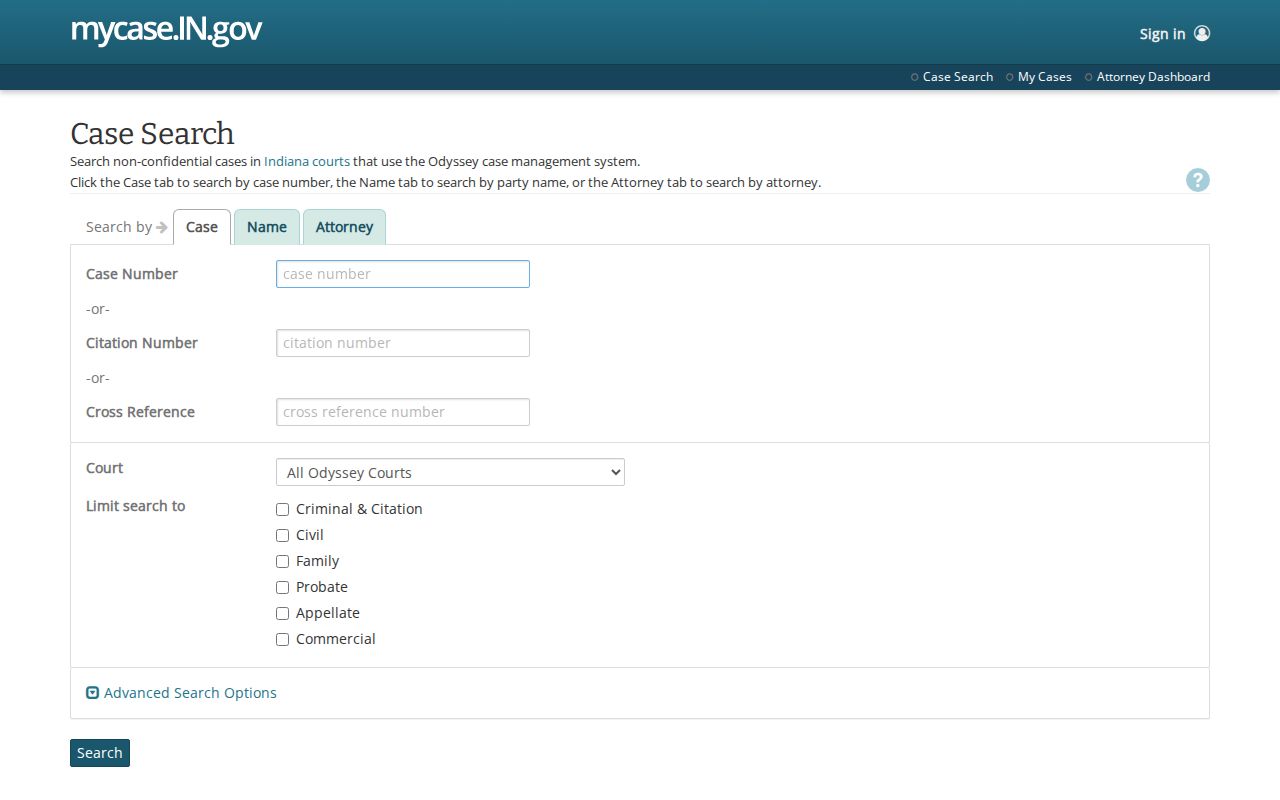
This is where case history starts; for a hearing date, the calendar and a direct call to the court still settle it.
LaGrange County Criminal Docket Courts
Under the LaGrange local rules, an IC 35-46-1-5 criminal case goes to Circuit. The Clerk receives all other criminal filings and splits them by random lot between Circuit and Superior to balance felony and misdemeanor work. Title 9 traffic-related counts land in Superior.
| Office | Role | Phone |
|---|---|---|
| Circuit, 44C01 | Selected criminal assignments. | (260) 499-6358 |
| Superior, 44D01 | Selected assignments and Title 9 counts. | (260) 499-6363 |
| County Clerk | Unified filing, copy, accounting, and access counter. | (260) 499-6371 |
No separate town criminal court sits in the current official lists. Search the county courts and the unified Clerk, not a town government site.
When LaGrange Criminal Cases Move
A file found under one code may later carry a transfer or cross-reference. Check the newest events before assuming the first court still controls the next hearing. When a LaGrange County criminal docket seems missing, drop date filters and run the exact number. Try both prefixes. Inspect cross references. The Clerk can also address older pre-Odyssey court records.
A blank result can also mean a sealed, expunged, confidential, or restricted matter. It does not prove that no record exists. Court staff will explain the lawful access route. They cannot disclose protected data just because an online search failed.
LaGrange Criminal Docket Documents
Know what you are asking for before you order. A charging document in a LaGrange County criminal docket states the accusation. Nothing more. A sentencing order records the sentence imposed after a qualifying disposition. MyCase often lets you pull sentencing orders from the felony and misdemeanor categories. Other filings stay in-person only or excluded. And a Case Summary event is not the document itself.
For an official copy, gather the case number, court, document name, and product type. The Clerk sells plain and certified copies. A transcript comes from the reporter for the court that heard the matter. Local rules cap a private transcript at $4.50 per page. Expedited work within five working days costs more. It runs no less than $7 per page. Confirm price and delivery before you order.
Access Rules for Criminal Dockets
Indiana opens its court records to the public, then draws firm lines around criminal dockets. Administrative Rule 1 states the principle, Rule 5 governs confidential material, redaction, and sealed files, and Rule 9 supplies the access procedures.
Public access has boundaries. Public headers, events, and permitted orders may show, while discovery, sealed exhibits, juvenile and mental-health records, protected identifiers, and other excluded filings may not.
An expungement that a court grants takes the case out of ordinary public view. Ask the clerk of the maintaining court about the proper route. Whatever the official file says controls over a cached search result or an outdated online balance.