
Name-Based LaGrange County Case Searches
The free MyCase public search is the main statewide route. It anchors any LaGrange County docket search. Choose the Name route when the cause number is unknown. A last name is required if a first name, middle name, or birth-date range is entered. Business searches use the Business field instead of the Last field. Those two routes are mutually exclusive. A sounds-like option can help with a spelling variation. It cannot be combined with a wildcard, though.
Start narrow. MyCase caps a search at 1,000 results and shows 20 per page. Pick LaGrange County, a status, a date range, and a case category. That trims the list without hiding a likely match.
- Open MyCase and select the Name tab.
- Enter the last name, or use Business for an organization.
- Select LaGrange County and add only reliable filters.
- Review court, file date, type, style, and status before opening a case.
| Field | Type | Required | LaGrange search note |
|---|---|---|---|
| Last or Business | Text | Yes | Use one path, not both |
| First / Middle | Text | No | Requires a last name |
| Birth date | Date range | No | Format shown as mm/dd/yyyy |
| Court | Dropdown | No | Select LaGrange County, internal ID 249 |
| Status | Choice | No | All, Open, or Closed |
| File date | Date range | No | Useful for common names |
LaGrange MyCase Search Paths
MyCase separates Case, Name, and Attorney searches. The Case tab accepts a case number, citation number, or cross-reference number as distinct exact identifiers. The Attorney tab accepts either an attorney number or an attorney name, not both. The Name tab searches people or businesses. That design matters because putting a traffic citation in the wrong field can produce no result even when the LaGrange County case exists.
The official MyCase search tips show the syntax, filters, result cap, and exact-number cautions. The captured help page below is assigned to this LaGrange County docket search and shows how Indiana tells users to refine broad results.
View the official MyCase search-tips source.
The search-tip controls earn their keep when a common name hits the system limit. They also help when an exact case number fails because a digit, court code, or search mode is wrong.
Case Number Searches
For one file, nothing beats an Indiana case number. Indiana Administrative Rule 8 sets the prefixes. LaGrange Circuit Court uses 44C01. LaGrange Superior Court uses 44D01. The rest of the number holds a year-month group. It also carries a case-type code and a six-digit sequence. The full shape looks like 44D01-YYMM-IF-######. That is only a format illustration, not a real case.
You may drop hyphens and leading zeroes, but the full printed number is safer. A transfer can swap the court prefix while keeping the sequence. A LaGrange County docket you expect may not appear. Try the other court prefix only when the record or transfer history supports it. And never read one failed exact search as proof the case does not exist. Indiana Rule 8 publishes the official code chart behind these prefixes.
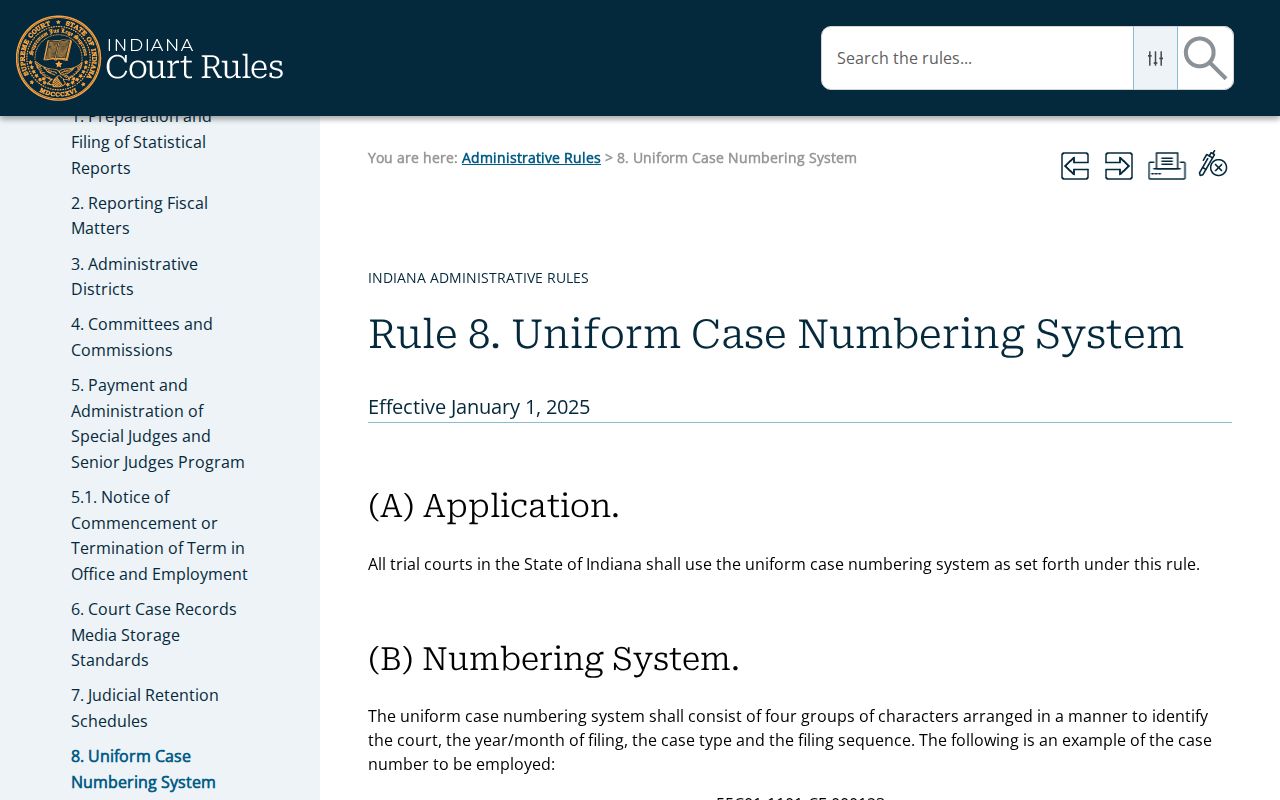
The chart separates court identifiers from case types. That split tells you at a glance whether a cause number belongs to Circuit or Superior Court.
LaGrange Docket Search Traps
A wildcard in MyCase only works at the end of a term. It is not a sounds-like search, and the two options cannot be combined. For a partial surname, put the asterisk last. Then narrow by court or file date. Never wildcard a citation or cross-reference number; those are exact matches. More filters are not always better, either. A wrong birth date can bury the right public result in the court docket. So can a closed-only choice or a tight file-date range.
Quick check: If a search exceeds 1,000 results, select LaGrange County, add a sound date range, and use a case category before changing the name.
Too many rapid searches can trip a CAPTCHA. Slow down and use the public interface as intended. Indiana warns against data mining, and no account is needed for ordinary public docket searching.
LaGrange Case Search Results Explained
A result row can carry a lot: the case number, county and court codes, the court, file date, status, status date, case type, case style, public or active indicators, parties, attorneys, and citation or charge data when available. Clicking through opens the Case Summary. That is MyCase's name for the public header plus the chronological events most people call the court docket.
| Case number | Identifies court, filing period, case type, and sequence. |
|---|---|
| Style | The short case caption, which may not display every protected name. |
| Status | Open or closed portal state, not a ruling by itself. |
| Case events | Public filings, hearings, orders, settings, and disposition rows in date order. |
| Cross references | Alternate identifiers, including a citation where applicable. |
| Documents | Only images allowed for remote public access by case type. |
Read events with care. A "converted" entry may mark migration from an older system, not a new filing. Financial data can go stale. For the current balance, the Clerk is the source, since a Case Summary is neither a transcript nor a certified copy of the court record.
Odyssey and Older LaGrange Files
Indiana's Odyssey court list shows a 2021 go-live for both LaGrange trial courts. Older events may have been converted into Odyssey. Some historical material may never have been digitized. A missing web result can come from an old index or a different court prefix. It might also come from a restricted case type, an expungement, a sealed order, or simply a search issue.
When an expected public cause is absent, call Kimbersey Johnson, LaGrange County Clerk. The number is (260) 499-6371. Circuit Court can be reached at (260) 499-6358. Superior Court is at (260) 499-6363. The courthouse counter at 105 North Detroit Street in LaGrange is the in-person fallback. There you can ask for a historical index search. You can also request an inspection route or a plain or certified copy as the facts require.
Two Ways to Search: County and State
LaGrange County has no separate county-only case database. MyCase is the statewide public layer built on Odyssey data, while the Clerk and each maintaining court hold the authoritative local file. The two routes complement each other. MyCase is quick and free. The local office can confirm a current balance, locate older material, explain lawful in-person access, and issue certified records.
| MyCase statewide route | LaGrange County local route |
|---|---|
| Free anonymous public search | Clerk or maintaining court contact |
| Name, case, and attorney modes | Counter, phone, inspection, and copy requests |
| Public Case Summary and allowed images | Official file and certification |
| Best first step for modern public cases | Best fallback for absent, old, or certified records |
Parties can link a case to an Indiana Courts account with a unique code, within set limits. Attorneys get more from the Courts Portal when they are counsel of record. Neither account unlocks what confidentiality rules still protect.
LaGrange Docket Identifier Terms
A handful of short labels on a LaGrange County court docket look almost identical, yet each one aims your case lookup at a different field. Check the source document first. Then pick your tab.
- Case number
- The Rule 8 cause number beginning with the court identifier.
- Citation number
- A traffic or infraction identifier used in MyCase or the ticket portal.
- Cross-reference number
- An exact alternate identifier linked to the case.
- Case Summary
- The public MyCase detail screen with header facts and available events.
- Case event
- A dated procedural row for a filing, setting, order, or disposition.
Labels describe the record. A code is not proof of a charge, liability, an outcome, or a current amount.
Which LaGrange Cases Stay Restricted
Indiana starts from a presumption that court records are open. Administrative Rule 5 then draws the exceptions. Mental-health files and most juvenile records may never appear remotely. The same goes for sealed cases, confidential identifiers, problem-solving supervision records, and anything shielded by law or court order. Protection-order cases follow special access rules of their own. A granted expungement can vanish from view. A pending or denied one may show differently. Seeing a case online does not mean every page in it is online. Indiana's case-type access matrix might reveal a public header or a non-confidential order. It can still hold back other images. When a document is listed but will not open, ask the Clerk about lawful in-person inspection. Never work around a sealed or excluded file. Rules 1, 2, 4, 5, and 9 of the Administrative Rules govern access overall. The Public Records Act helps with county administrative material. It cannot turn a confidential judicial file public. Once you find a cause number, the LaGrange County court case records process handles copies and certification.
Verify a LaGrange Court Docket
Always read the newest event before trusting a status or hearing date. An old setting can linger on the docket after a continuance or reset. For a firm date, compare the Case Summary against the Indiana Court Calendar. Then call the court when a hearing is close or the two disagree. Court Calendar is a limited schedule, not a substitute for the case file itself. When you need an official result, hand the Clerk the full cause number. Include the court, the document or event title, and the date. Say exactly what product you want. It could be a plain copy, a certified copy, a Case Summary printout, or a transcript. Each is a distinct record. That discipline is what makes LaGrange County docket search data genuinely useful. It stops you from treating a web result as final proof. Note: A public MyCase result is a fine way to find a case. The maintaining court still controls the record that counts.